
Between Neutrality and NATO: Moldova's Strategic Hedging in Practice

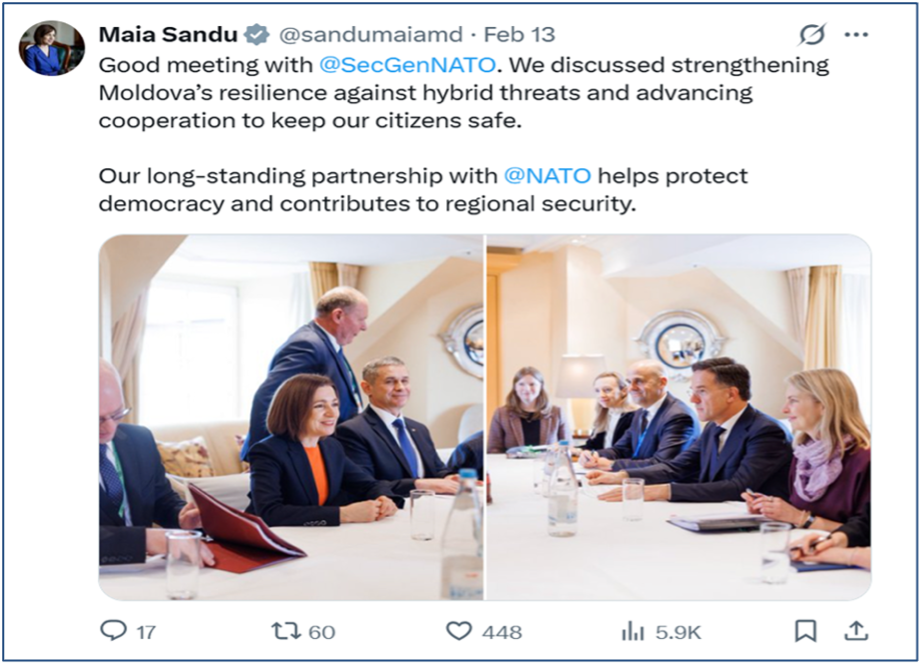
On February 13th, 2026, Moldova President Maia Sandu posted on X: “Good meeting with @SecGenNATO. We discussed strengthening Moldova’s resilience against hybrid threats and advancing cooperation to keep our citizens safe. Our long-standing partnership with @NATO helps protect democracy and contributes to regional security.”
The deepening of security and defense ties with the European Union has become central to Moldova's EU accession ambitions, alongside expanded engagement with NATO. Since 2022, efforts to reduce Moldova's dependence on Russia have intensified, including closer alignment with EU-led sanctions. However, several challenges remain.
Constitutionally, Moldova remains a neutral state; however, growing debate within the country is raising questions about whether neutrality alone can guarantee territorial integrity and temper Russian ambitions following the invasion of Ukraine. While neutrality has historically enabled smaller states to preserve autonomy without full alignment, Moldova’s neutrality is now in a challenging position.
Transnistria, a strip of land along Moldova's eastern border, first declared independence in August 1991, following the failed Soviet coup, and formally constituted itself as the Pridnestrovian Moldovan Republic by November 1991. Rather than joining the newly independent Moldovan state, Transnistrian authorities pursued a separate political path, precipitating an armed conflict in 1992. Russia intervened under the pretext of protecting its Russian-speaking populations. The 1992 conflict ended in a ceasefire but was never formally resolved, leaving Transnistria (now formally known as the Pridnestrovian Moldovan Republic) in a protracted frozen conflict.
The fluctuating geopolitical orientation is rooted in domestic political history. Political polarization between pro-European and pro-Russian factions intensified during the 2009 and 2016 elections, marked by accusations of foreign allegiance and national betrayal, which drew more external powers into political competition. The two elections were highly contentious, with large protests both on the ground and in cyberspace.
Since re-election in November 2024, Maia Sandu has publicly challenged Russian interference and distanced herself from previous Russian diplomatic ties. In light of the current geopolitical climate, this tweet comes amid Moldova’s ongoing efforts to balance cooperation with Western institutions while maintaining formal neutrality amid regional instability. On the one hand, Moldova has accelerated its pursuit of EU integration following Maia Sandu’s re-election. On the other hand, such moves during heightened regional tension and an ongoing war are likely to undermine neutrality efforts and pose credible security challenges for the country. As a result, EU integration remains visible and active, but full alignment with Western values remains incremental. Moldova remains a constitutionally neutral state, yet is actively engaged in the NATO Partnership Framework. For example, Moldova cooperates with NATO through programs such as the Individual Partnership Action Plan (IPAP) and the NATO Partnership for Peace.
This context raises an important analytical question: Do Maia Sandu's comments suggest a shift in Moldova's strategic orientation or signal continuity in its hedging position amid mounting security pressure? I argue that Sandu remains firmly committed to strategic hedging. This report evaluates whether her language signals a strategic shift or continuity in hedging. It also considers whether the discourse, together with observable behavioral engagement, indicates movement beyond rhetorical positioning toward Western alignment.
Moldova's neutrality functions not as passive abstention but as a strategic balancing orientation within a contested geopolitical environment, short of formal military alignment. The lexical choice of ‘resilience’ is not aggressive; it highlights Moldova's vulnerability, foregrounds its defensive capacity, and avoids militarized rhetoric. The categorization of ‘Moldova's resilience’ implies exposure to ongoing security pressures but does not explicitly address the security issues stemming from Russian influence. This is reinforced by the term ‘hybrid threats,’ which implicitly refers to Russia. However, the lack of direct attribution in NATO discussions reflects Moldova's current hedging position, visibly aligned with the West but calibrated in response to regional instability. Additionally, ‘hybrid’ may be seen as bureaucratic language that softens attributions, avoids a confrontational tone, and preserves neutral ambiguity.
The term ‘advancing’ seems to serve several purposes: it does not imply a full alignment shift toward Western power, nor is it an aggressive or challenging term; rather, it suggests gradual progression rather than a structural transition. It implies incrementalism, which is central to the current geopolitical orientation strategy.
Sandu’s categorization of the Moldova-NATO relationship as a ‘long-standing partnership’ anchors democratic alignment without over-dramatizing NATO cooperation; the term ‘partnership’ implies routine engagement and reduces the rhetoric of a policy shift. This muted tone is repeated in ‘protection of democracy’; it highlights Western alignment but avoids a militarized framing, justifying NATO cooperation as compatible with constitutional neutrality and helping maintain the continuity of the hedging strategy. This framing allows her to present ‘regional security’ as the singular factor, subtly diffusing direct Russian attribution and presenting NATO as a collective guarantor of stability rather than Moldova seeking protection alone, thereby softening perceptions of dependency.
The tweet, though short, has three points of discursive framing. First, neutrality, which is neither mentioned nor contradicted; the silence itself is strategic rather than passive and follows geopolitical positioning, reinforced by the absence of membership language. The second is the tone used. Unlike previous tweets this quarter on Ukraine, which condemn and use common emotive language, this tweet is calm and bureaucratic, again supporting a hedging position. Thirdly, Sandu avoids direct reference to Russia while explicitly tagging the NATO account, visibly aligning Moldova within the Western institutional network for its intended audience, yet maintains continuity through indirect attribution. It also includes photos from the meeting; the photos are staged with no NATO branding or flags, which visibly reinforce the absence of membership signaling and sustain Moldova as a constitutional neutral state. This tweet does not suggest pursuing NATO membership or realignment, but rather reflects a pre-existing hedging strategy expressed in the language of cooperation.
In her October 27, 2025, speech, delivered after the September 28 parliamentary elections, Sandu addressed cyberattacks on the election process:
“We cooperate with NATO through our programs. This summer, when we discovered a major cybersecurity vulnerability, NATO mobilized resources and provided equipment to protect the integrity of the elections and prevent Russian interference. We will continue to accept help from NATO or member countries for expensive equipment. We must invest in cybersecurity alongside digitalization, or we create vulnerabilities.”
This excerpt from Sandu’s speech addresses cybersecurity concerns and NATO support, with the opening ‘we cooperate’ maintaining continuity in geopolitical positioning and avoiding membership rhetoric. Sandu not only names NATO as a partner but also details the support provided, foregrounding Moldova not as a passive recipient but as an active partner. The direct public mention of Russia within this NATO context further separates Moldova from Russia, and this gap is seen as supporting government action, such as the active application to join the EU. It further condemns Russian actions as a pattern, not limited to cybersecurity instability.
The speech’s significance lies in the phrase ‘accepts help’ rather than ‘asks for help’, mirroring the tweet: Moldova is visibly a partner without implying an alliance commitment. Additionally, both discourses repeat ‘cooperation’ and refer to the protection of ‘integrity’ and ‘democracy’. This discursive choice functions as a double bind, as ‘cooperation’ relies on protection within the hedging framework. The tweet ‘advancing cooperation’ is stronger yet incremental, reflecting a language shift from acceptance, indicating increased confidence without strategic abandonment.
The most visible difference between the two is the number of mentions of NATO versus Russia, and how that ratio shifts across the speech and the tweet. Taken months apart, the speech explicitly names Russia, whereas the tweet only implies a Russian threat. However, this difference is not an inconsistency but rather an audience-dependent one. This asymmetry suggests increasing comfort with visible NATO alignment while maintaining caution about direct confrontation. This shift reflects not the abandonment of hedging but its maturation: threat identification remains, yet the response is framed as routine, cooperative, and embedded within democratic protection rather than alliance dependency.
Sandu’s language suggests a continuation of a hedging strategy, with subtle shifts between attitude and behavior that help sustain diplomatic engagement alongside operational cooperation. Indeed, the absence of a membership narrative does not signal reservations about cooperation. Rather, it is part of that ongoing strategy. The tweet marks operational cooperation while maintaining constitutional neutrality, reflecting the reality that neutrality alone does not guarantee regional security. References to cybersecurity and partnership further indicate that Moldova’s positioning is not solely rhetorical. Moldova’s relationship with NATO extends beyond chosen rhetoric into practical interaction. Moldova, therefore, appears closer to NATO in practical cooperation, while deliberately avoiding membership commitments that could provoke Russia.


